 Add to Chrome
 Add to Firefox
 Add to Edge
Zeroth-Order Nonconvex Nonsmooth Optimization with Heavy-Tailed Noise
May 23, 2026
This paper considers the nonconvex nonsmooth problem in which the objective function is Lipschitz continuous. We focus on the stochastic setting where the algorithm can access stochastic function value evaluations with heavy-tailed noise, which is prevalent in many popular machine learning applications. We propose a stochastic zeroth-order algorithm that refines the framework of online-to-nonconvex conversion by clipping the two-point gradient estimator. The theoretical analysis shows that our algorithm can find a $(δ, ε)$-Goldstein stationary point with zeroth-order oracle complexity of ${\mathcal O}(d^{\frac{p}{2(p-1)}}δ^{-1}ε^{-\frac{2p-1}{p-1}})$, where $d$ is the problem dimension and $p\in(1,2]$ is the order of bounded moments. Note that our dependence on dimension $d$ matches the best-known results of stochastic zeroth-order optimization for finding the sub-optimal solution of a stochastic convex nonsmooth problem. In addition, our dependence on accuracy parameters $δ$ and $ε$ is consistent with that of the best-known stochastic first-order algorithms for stochastic nonconvex nonsmooth problems. Finally, we conduct numerical experiments to demonstrate the effectiveness of the proposed method.

On the Convergence of Single-Loop Stochastic Bilevel Optimization with Approximate Implicit Differentiation
Feb 27, 2026Stochastic Bilevel Optimization has emerged as a fundamental framework for meta-learning and hyperparameter optimization. Despite the practical prevalence of single-loop algorithms--which update lower and upper variables concurrently--their theoretical understanding, particularly in the stochastic regime, remains significantly underdeveloped compared to their multi-loop counterparts. Existing analyses often yield suboptimal convergence rates or obscure the critical dependence on the lower-level condition number $κ$, frequently burying it within generic Lipschitz constants. In this paper, we bridge this gap by providing a refined convergence analysis of the Single-loop Stochastic Approximate Implicit Differentiation (SSAID) algorithm. We prove that SSAID achieves an $ε$-stationary point with an oracle complexity of $\mathcal{O}(κ^7 ε^{-2})$. Our result is noteworthy in two aspects: (i) it matches the optimal $\mathcal{O}(ε^{-2})$ rate of state-of-the-art multi-loop methods (e.g., stocBiO) while maintaining the computational efficiency of a single-loop update; and (ii) it provides the first explicit, fine-grained characterization of the $κ$-dependence for stochastic AID-based single-loop methods. This work demonstrates that SSAID is not merely a heuristic approach, but admits a rigorous theoretical foundation with convergence guarantees competitive with mainstream multi-loop frameworks.
Decentralized Non-convex Stochastic Optimization with Heterogeneous Variance
Feb 12, 2026Decentralized optimization is critical for solving large-scale machine learning problems over distributed networks, where multiple nodes collaborate through local communication. In practice, the variances of stochastic gradient estimators often differ across nodes, yet their impact on algorithm design and complexity remains unclear. To address this issue, we propose D-NSS, a decentralized algorithm with node-specific sampling, and establish its sample complexity depending on the arithmetic mean of local standard deviations, achieving tighter bounds than existing methods that rely on the worst-case or quadratic mean. We further derive a matching sample complexity lower bound under heterogeneous variance, thereby proving the optimality of this dependence. Moreover, we extend the framework with a variance reduction technique and develop D-NSS-VR, which under the mean-squared smoothness assumption attains an improved sample complexity bound while preserving the arithmetic-mean dependence. Finally, numerical experiments validate the theoretical results and demonstrate the effectiveness of the proposed algorithms.
Sign-Based Optimizers Are Effective Under Heavy-Tailed Noise
Feb 07, 2026While adaptive gradient methods are the workhorse of modern machine learning, sign-based optimization algorithms such as Lion and Muon have recently demonstrated superior empirical performance over AdamW in training large language models (LLM). However, a theoretical understanding of why sign-based updates outperform variance-adapted methods remains elusive. In this paper, we aim to bridge the gap between theory and practice through the lens of heavy-tailed gradient noise, a phenomenon frequently observed in language modeling tasks. Theoretically, we introduce a novel generalized heavy-tailed noise condition that captures the behavior of LLMs more accurately than standard finite variance assumptions. Under this noise model, we establish sharp convergence rates of SignSGD and Lion for generalized smooth function classes, matching or surpassing previous best-known bounds. Furthermore, we extend our analysis to Muon and Muonlight, providing what is, to our knowledge, the first rigorous analysis of matrix optimization under heavy-tailed stochasticity. These results offer a strong theoretical justification for the empirical superiority of sign-based optimizers, showcasing that they are naturally suited to handle the noisy gradients associated with heavy tails. Empirically, LLM pretraining experiments validate our theoretical insights and confirm that our proposed noise models are well-aligned with practice.
Optimal Asynchronous Stochastic Nonconvex Optimization under Heavy-Tailed Noise
Jan 27, 2026This paper considers the problem of asynchronous stochastic nonconvex optimization with heavy-tailed gradient noise and arbitrarily heterogeneous computation times across workers. We propose an asynchronous normalized stochastic gradient descent algorithm with momentum. The analysis show that our method achieves the optimal time complexity under the assumption of bounded $p$th-order central moment with $p\in(1,2]$. We also provide numerical experiments to show the effectiveness of proposed method.
Stability and Generalization of Nonconvex Optimization with Heavy-Tailed Noise
Jan 27, 2026The empirical evidence indicates that stochastic optimization with heavy-tailed gradient noise is more appropriate to characterize the training of machine learning models than that with standard bounded gradient variance noise. Most existing works on this phenomenon focus on the convergence of optimization errors, while the analysis for generalization bounds under the heavy-tailed gradient noise remains limited. In this paper, we develop a general framework for establishing generalization bounds under heavy-tailed noise. Specifically, we introduce a truncation argument to achieve the generalization error bound based on the algorithmic stability under the assumption of bounded $p$th centered moment with $p\in(1,2]$. Building on this framework, we further provide the stability and generalization analysis for several popular stochastic algorithms under heavy-tailed noise, including clipped and normalized stochastic gradient descent, as well as their mini-batch and momentum variants.
Near-Optimal Decentralized Stochastic Nonconvex Optimization with Heavy-Tailed Noise
Jan 16, 2026This paper studies decentralized stochastic nonconvex optimization problem over row-stochastic networks. We consider the heavy-tailed gradient noise which is empirically observed in many popular real-world applications. Specifically, we propose a decentralized normalized stochastic gradient descent with Pull-Diag gradient tracking, which achieves approximate stationary points with the optimal sample complexity and the near-optimal communication complexity. We further follow our framework to study the setting of undirected networks, also achieving the nearly tight upper complexity bounds. Moreover, we conduct empirical studies to show the practical superiority of the proposed methods.
Accelerated Evolving Set Processes for Local PageRank Computation
Oct 09, 2025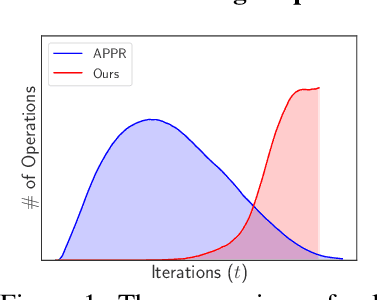
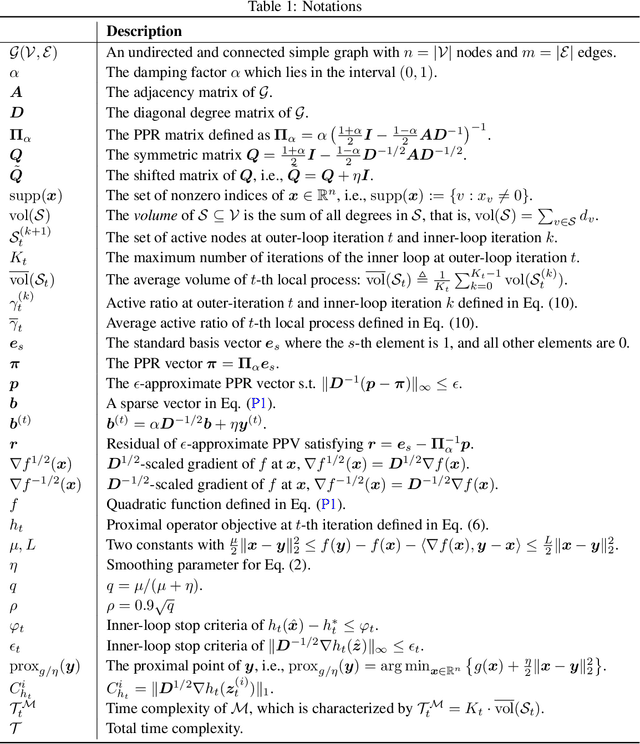
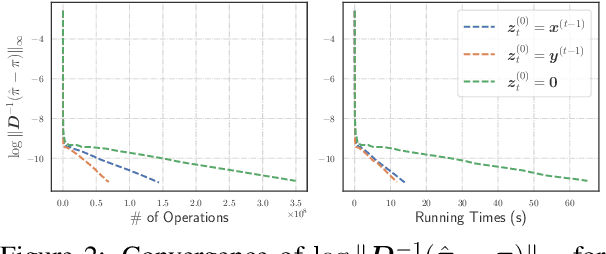

This work proposes a novel framework based on nested evolving set processes to accelerate Personalized PageRank (PPR) computation. At each stage of the process, we employ a localized inexact proximal point iteration to solve a simplified linear system. We show that the time complexity of such localized methods is upper bounded by $\min\{\tilde{\mathcal{O}}(R^2/\epsilon^2), \tilde{\mathcal{O}}(m)\}$ to obtain an $\epsilon$-approximation of the PPR vector, where $m$ denotes the number of edges in the graph and $R$ is a constant defined via nested evolving set processes. Furthermore, the algorithms induced by our framework require solving only $\tilde{\mathcal{O}}(1/\sqrt{\alpha})$ such linear systems, where $\alpha$ is the damping factor. When $1/\epsilon^2\ll m$, this implies the existence of an algorithm that computes an $\ epsilon $-approximation of the PPR vector with an overall time complexity of $\tilde{\mathcal{O}}\left(R^2 / (\sqrt{\alpha}\epsilon^2)\right)$, independent of the underlying graph size. Our result resolves an open conjecture from existing literature. Experimental results on real-world graphs validate the efficiency of our methods, demonstrating significant convergence in the early stages.
Stochastic Bilevel Optimization with Heavy-Tailed Noise
Sep 18, 2025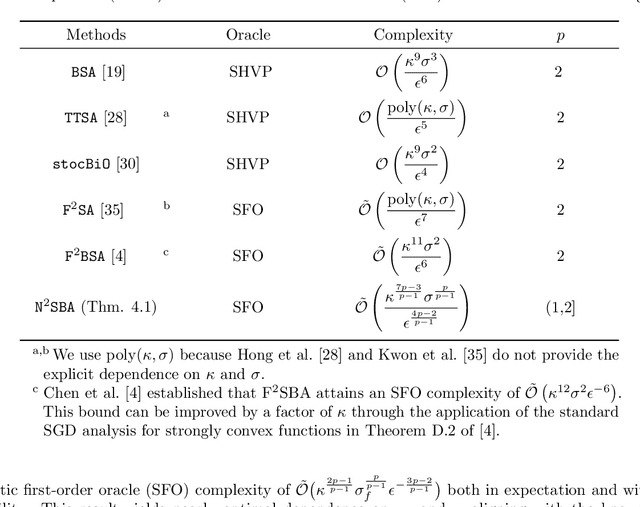
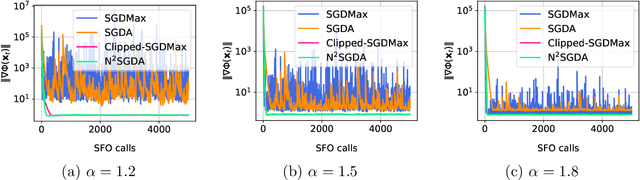
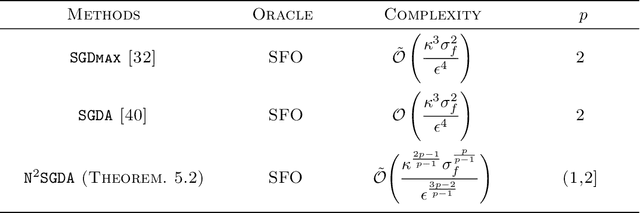
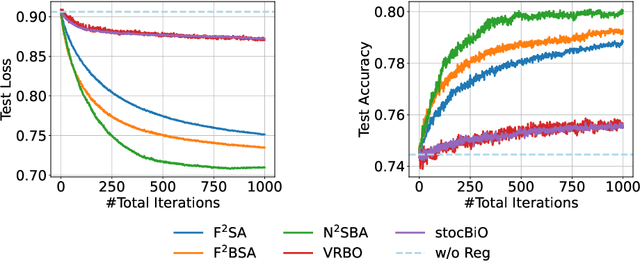
This paper considers the smooth bilevel optimization in which the lower-level problem is strongly convex and the upper-level problem is possibly nonconvex. We focus on the stochastic setting that the algorithm can access the unbiased stochastic gradient evaluation with heavy-tailed noise, which is prevalent in many machine learning applications such as training large language models and reinforcement learning. We propose a nested-loop normalized stochastic bilevel approximation (N$^2$SBA) for finding an $\epsilon$-stationary point with the stochastic first-order oracle (SFO) complexity of $\tilde{\mathcal{O}}\big(\kappa^{\frac{7p-3}{p-1}} \sigma^{\frac{p}{p-1}} \epsilon^{-\frac{4 p - 2}{p-1}}\big)$, where $\kappa$ is the condition number, $p\in(1,2]$ is the order of central moment for the noise, and $\sigma$ is the noise level. Furthermore, we specialize our idea to solve the nonconvex-strongly-concave minimax optimization problem, achieving an $\epsilon$-stationary point with the SFO complexity of $\tilde{\mathcal O}\big(\kappa^{\frac{2p-1}{p-1}} \sigma^{\frac{p}{p-1}} \epsilon^{-\frac{3p-2}{p-1}}\big)$. All above upper bounds match the best-known results under the special case of the bounded variance setting, i.e., $p=2$.
Decentralized Stochastic Nonconvex Optimization under the Relaxed Smoothness
Sep 10, 2025This paper studies decentralized optimization problem $f(\mathbf{x})=\frac{1}{m}\sum_{i=1}^m f_i(\mathbf{x})$, where each local function has the form of $f_i(\mathbf{x}) = {\mathbb E}\left[F(\mathbf{x};{\xi}_i)\right]$ which is $(L_0,L_1)$-smooth but possibly nonconvex and the random variable ${\xi}_i$ follows distribution ${\mathcal D}_i$. We propose a novel algorithm called decentralized normalized stochastic gradient descent (DNSGD), which can achieve the $\epsilon$-stationary point on each local agent. We present a new framework for analyzing decentralized first-order methods in the relaxed smooth setting, based on the Lyapunov function related to the product of the gradient norm and the consensus error. The analysis shows upper bounds on sample complexity of ${\mathcal O}(m^{-1}(L_f\sigma^2\Delta_f\epsilon^{-4} + \sigma^2\epsilon^{-2} + L_f^{-2}L_1^3\sigma^2\Delta_f\epsilon^{-1} + L_f^{-2}L_1^2\sigma^2))$ per agent and communication complexity of $\tilde{\mathcal O}((L_f\epsilon^{-2} + L_1\epsilon^{-1})\gamma^{-1/2}\Delta_f)$, where $L_f=L_0 +L_1\zeta$, $\sigma^2$ is the variance of the stochastic gradient, $\Delta_f$ is the initial optimal function value gap, $\gamma$ is the spectral gap of the network, and $\zeta$ is the degree of the gradient dissimilarity. In the special case of $L_1=0$, the above results (nearly) match the lower bounds on decentralized nonconvex optimization in the standard smooth setting. We also conduct numerical experiments to show the empirical superiority of our method.